

Your neighbour pays RM20 for electricity. You pay RM500. Same neighbourhood, similar houses. What's the difference?
Solar panels can significantly reduce electricity bills, but here's what many homeowners don't realise: two homes with identical solar systems can experience very different savings.
Why? Because solar savings depend on more than how much electricity your panels generate.
1. How Do Solar Panels Reduce Your TNB Bill?
Solar panels generate electricity during daylight hours, allowing your home to use solar energy instead of purchasing electricity from TNB.
The more solar electricity your household consumes directly, the less electricity you need to buy from the grid.
However, your actual savings depend on three important factors:
Solar generation: How much electricity your system produces.
Self-consumption: How much solar electricity your household uses directly.
Grid export: How much excess electricity is sent back to TNB.
Understanding these factors is key to maximising your solar investment.
2. Why Does Daytime Electricity Consumption Matter?
Imagine two households with identical solar installations.
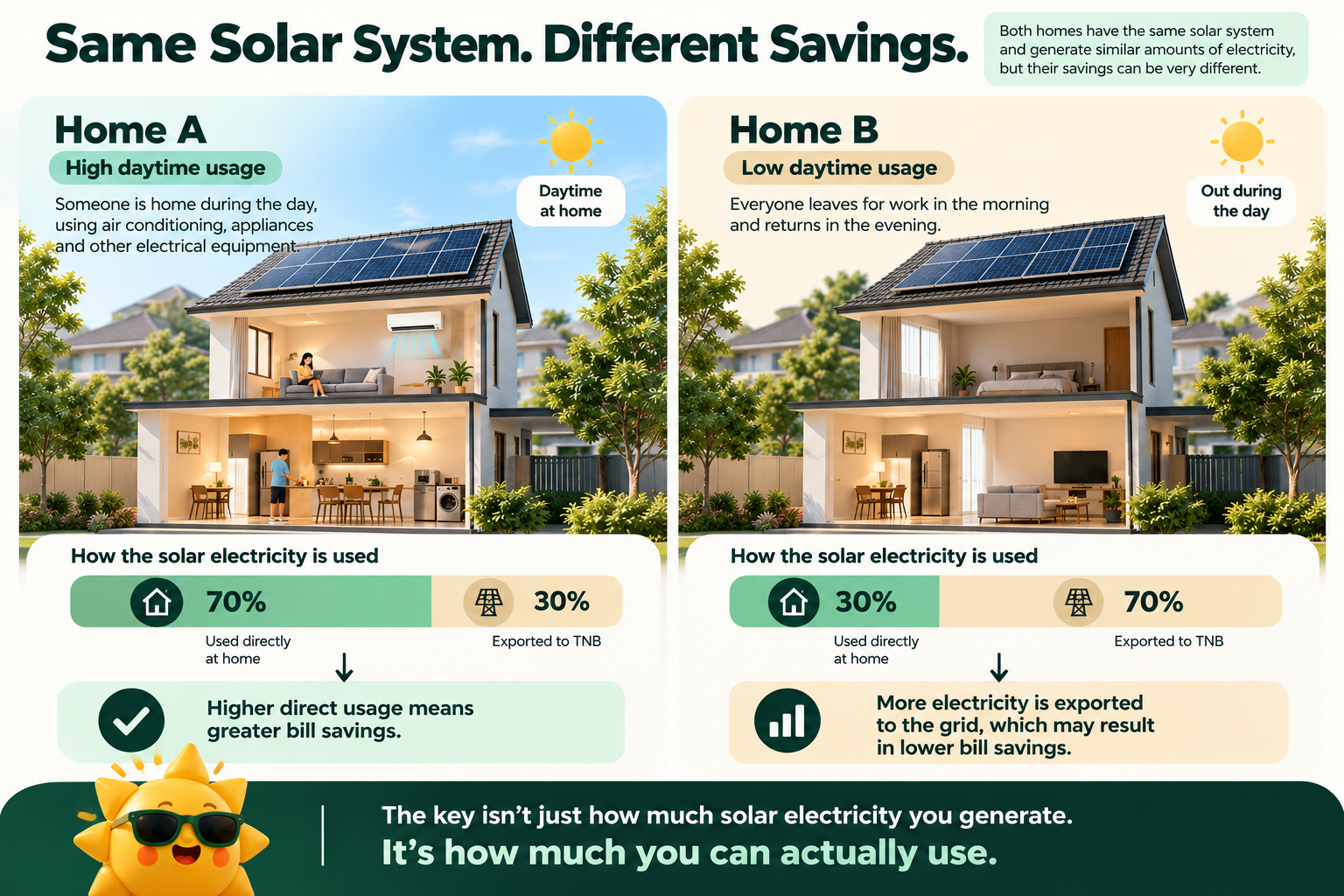
The key isn't just how much solar electricity you generate. It's how much you can actually use.
3. What Happens to Excess Solar Electricity Under Solar ATAP?
Malaysia's Solar Accelerated Transition Action Programme (Solar ATAP) allows eligible solar users to export surplus electricity to the grid and receive credits under the programme's applicable rules.
However, exported electricity is not necessarily credited at the same value as electricity you avoid purchasing from TNB.
This means using solar electricity directly can be more financially valuable than exporting it.
For homeowners considering solar installation in Malaysia, understanding the difference between self-consumption and export credits is essential.
4. Does Installing More Solar Panels Mean Bigger Savings?
Not necessarily.
A larger solar system generates more electricity, but that doesn't automatically translate into proportionally higher bill savings.
If your system consistently produces more electricity than your household can use or receive eligible export credits for, the additional generation may provide limited financial benefit.
That's why solar system sizing should consider:
Your monthly electricity consumption
Daytime versus nighttime usage
Roof orientation and available space
Applicable export-credit arrangements
Future electricity requirements
The best solar system isn't always the biggest. It's the one that matches your household's energy needs.
5. How Can You Maximise Your Solar Savings?
You don't necessarily need more panels to get more value from solar.
Sometimes, changing when you use electricity can make a difference.
For example, consider running washing machines, dishwashers or other flexible electrical loads during daylight hours.
Homeowners with electric vehicles may also benefit from daytime charging when practical.
The goal is simple: use more of the electricity your solar panels generate before exporting the surplus.
6. How Can You Estimate Your Solar Savings?
Your latest TNB electricity bill is a useful starting point.
It helps identify your monthly electricity consumption and provides a basis for estimating an appropriately sized solar system.
However, your bill alone doesn't reveal exactly when your household consumes electricity.
A more meaningful solar assessment considers your usage patterns, roof conditions and expected solar generation.
At Dalus Energy, we use these factors to develop a proposal tailored to your home rather than relying on generic savings promises.
Generate Smart. Consume Smarter.
More solar panels don't always mean greater savings.
The key is designing a system that works with your household's electricity consumption.
At Dalus Energy, we focus on maximising your savings through smarter system design, not simply installing more panels.