

Imagine this. It's a sunny afternoon, your solar panels are generating electricity, and suddenly, the entire neighbourhood loses power.
You look up at your roof. The sun is still shining. Your panels are right there.
So why are your lights off too?
Here's something that surprises many homeowners:
Having solar panels doesn't automatically mean your home has backup electricity.
In fact, most standard grid-connected solar systems are designed to shut down during a power outage.
And there's a very good reason for that.
1. Why Do Solar Panels Shut Down During a Blackout?
It all comes down to safety.
Most residential solar systems in Malaysia are connected to the TNB electricity grid.
When the grid experiences a power outage, a standard grid-connected solar inverter automatically stops supplying electricity.
This safety feature is called anti-islanding protection.
Why is it necessary?
Imagine TNB technicians repairing a damaged power line. If solar systems continued feeding electricity into the grid, those lines could remain energised, putting workers at risk.
Anti-islanding protection prevents this from happening.
So, even if your panels are receiving plenty of sunlight, your standard grid-connected system will stop supplying power when the grid goes down.
It's not a malfunction. It's an important safety feature.
2. Can Solar Panels Work Without the TNB Grid?
Yes, but only if your system is specifically designed for it.
Not all solar installations operate the same way during a blackout.
Some systems rely entirely on the electricity grid, while others are equipped to supply backup power independently.
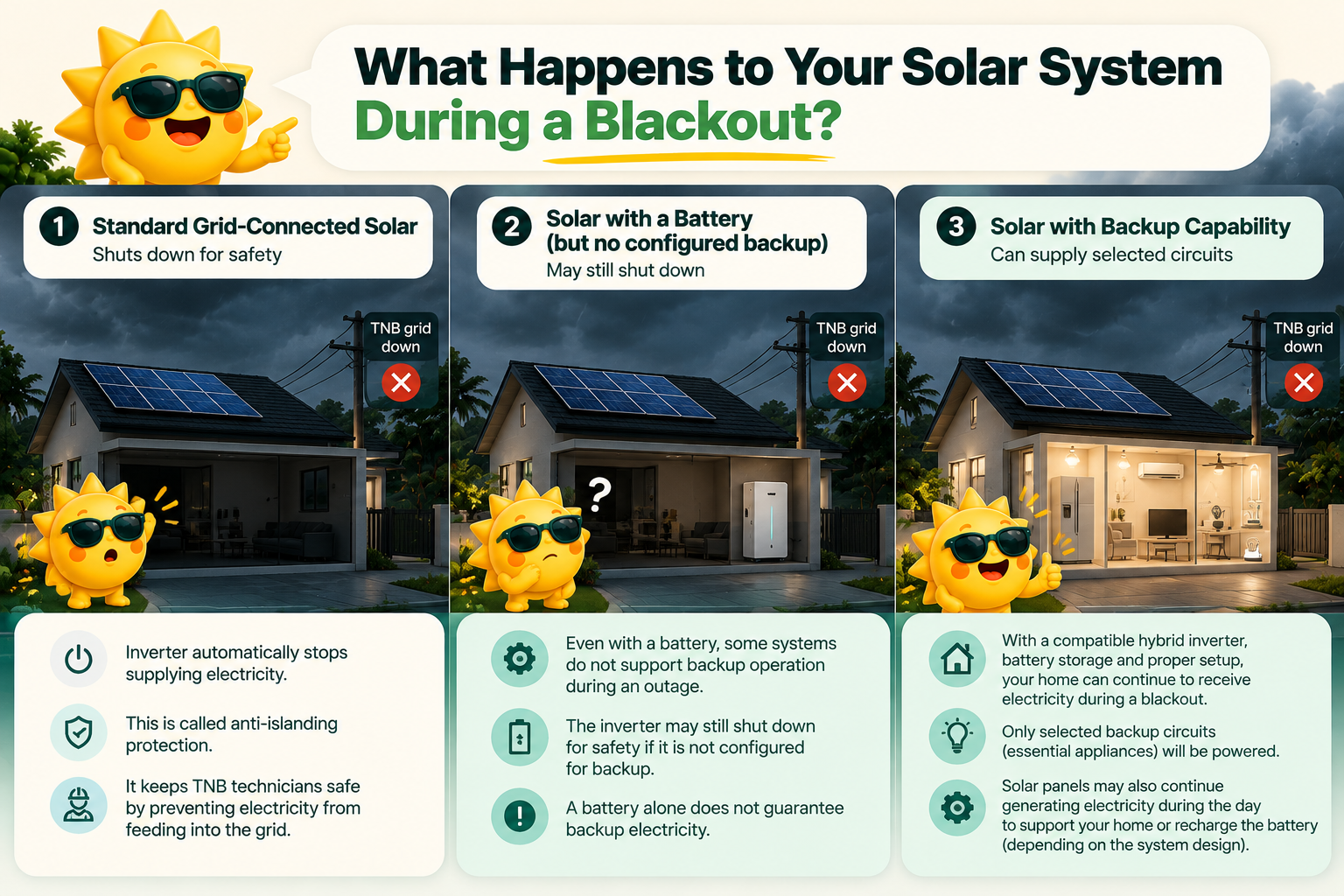
The key difference isn't simply whether you have solar panels or a battery.
It's whether your inverter and electrical installation support backup operation.
A backup-capable system must be able to safely isolate its backup circuits from the grid during an outage.
Without the necessary equipment and configuration, even a system with battery storage may be unable to power your home during a blackout.
3. Do You Need a Battery for Backup Power?
For most homeowners who want reliable backup electricity, a battery is the practical solution.
But here's the important part:
A battery alone doesn't guarantee backup power.
A properly designed residential backup system typically requires:
A compatible hybrid inverter with backup capability.
Battery storage to supply electricity when needed.
Appropriate switching and electrical protection.
Designated backup circuits connected to essential appliances.
When the grid goes down, the system can isolate the backup supply from the grid and continue powering selected household circuits, provided sufficient energy is available.
Depending on the equipment and configuration, solar panels may also continue generating electricity to support those circuits or recharge the battery during daylight.
However, not every hybrid inverter supports this function, and backup operation must be confirmed during system design.
4. Can Solar Power Your Entire House During a Blackout?
That depends on what you're trying to power.
Imagine a blackout on a hot Malaysian afternoon.
You want your refrigerator running, your Wi-Fi connected, a few lights switched on and perhaps a fan keeping the room comfortable.
These are relatively modest electrical loads.
Now imagine running multiple air conditioners, an electric oven and a water heater at the same time.
That's a very different level of electricity demand.
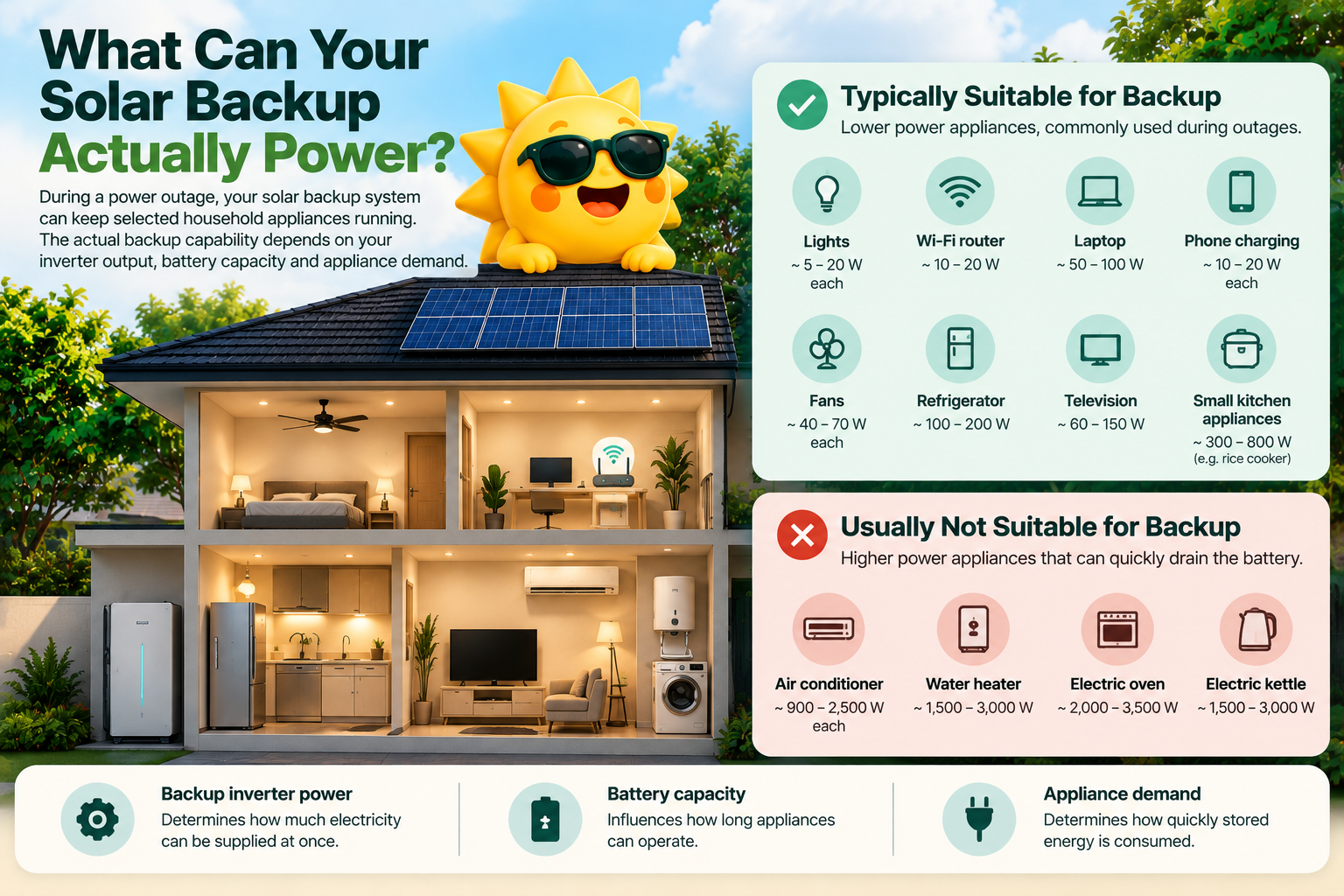
A backup system's capability depends on three important factors:
Backup inverter power: Determines how much electricity can be supplied at once.
Battery capacity: Influences how long appliances can operate.
Appliance demand: Determines how quickly stored energy is consumed.
That's why backup systems are often designed around essential loads, rather than automatically supplying every appliance in the house.
5. What Should You Ask Before Installing Solar?
If having electricity during a blackout matters to you, bring it up before finalising your solar quotation.
Here are three useful questions to ask your installer:
1. Will my proposed solar system provide electricity during a TNB outage?
Don't assume that every hybrid inverter includes an operational backup function.
2. Which appliances will remain powered?
Ask whether your backup system will support selected essential circuits or a larger portion of your home.
3. Can I add backup capability later?
If you're starting with solar only, discuss whether your proposed inverter and electrical configuration can accommodate future battery storage and backup requirements.
Planning ahead can help avoid unnecessary equipment changes later.
Solar Savings and Backup Power Are Two Different Things
Solar panels can help reduce your electricity bills, but they don't automatically protect your home from blackouts.
Standard grid-connected systems shut down during outages for safety. To keep selected appliances running, you'll need a properly designed backup-capable system.
The right solution depends on what matters most to you: lowering electricity costs, maintaining essential power during outages, or achieving both.